The Rand, rebuilt for business


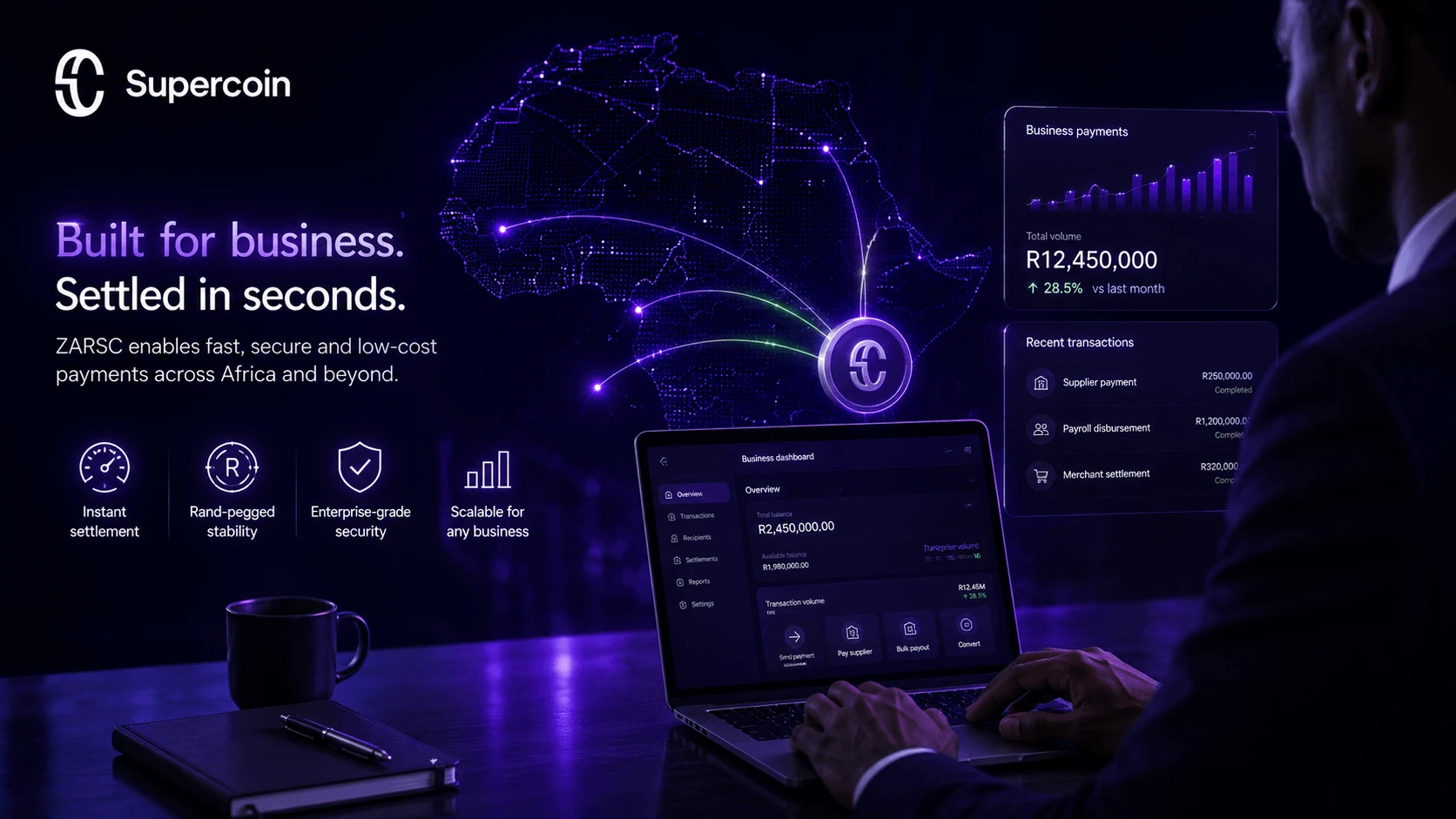
South African businesses navigate legacy payment infrastructure every day. Settlement timelines that span working days. Cut-off times. Reconciliation at month-end. None of it was designed for a country that increasingly trades around the clock. ZARsc is not a replacement for cards or banks. It is a new rail running alongside them, available 24/7, designed for use cases where time, cost, and continuous availability matter. This piece is about six of those use cases, and what becomes possible when settlement happens in seconds.
What card and EFT rails do well, and where they reach their limits
Before talking about what stablecoin settlement does differently, it is worth being honest about what existing rails do well.
Card rails are widely accepted, well understood, and trusted by consumers. The acceptance network in South Africa is mature. The user experience at the till is good. The fraud protection and dispute resolution mechanisms work.
EFT rails are cost-effective for the sender. They are widely used for B2B and bulk payments. The South African banking system is one of the most developed in the region.
Where both rails reach their limits is on three dimensions: time, transaction cost, and operating hours.
Published industry figures cited by the Payments Association of South Africa and inferred from SARB's National Payment System data put card acquiring fees in South Africa at typically 2 to 3% and settlement times at 48 to 72 hours [1]. EFT clearing windows are typically one to three working days [2]. Neither rail operates in a true 24/7 real-time mode. For a business running on tight working capital, with a global supply chain, with gig workers expecting same-day pay, or with customers who shop on a Sunday morning, those limits add up. They show up as overdrafts. They show up as reconciliation friction. They show up in the parts of the business that should be frictionless.
Same Rand. Different rails. ZARsc is not a replacement for cards or banks. It is a new option, available 24/7.Six use cases. One rail.
ZARsc is built for use cases where time, cost, and 24/7 availability matter. Here are six of them. Each describes what stablecoin settlement infrastructure can do in general. How that translates into outcomes for a specific business will depend on volumes, integration, and the partner architecture chosen.
1. Merchant settlement
Settle in seconds rather than over multiple working days. For PSPs, acquirers, fintechs, and marketplaces, stablecoin rails offer an alternative to the timing characteristics of existing card and EFT settlement. Available 24/7. Operates on weekends and after hours.
2. Treasury and corporate payments
Always-on treasury operations. Intercompany settlement between subsidiaries. Supplier payments. Working capital management on programmable rails. For franchise groups, FMCG operators, logistics businesses, and platforms with multi-entity structures, ZARsc offers a continuous, programmable settlement layer that can run alongside existing banking relationships.
3. Embedded finance
Every platform can become a payment platform. Integrate ZARsc as a payment rail inside your app or your checkout. Lower transaction costs, rapid confirmation, programmable payouts. For ride-hailing, marketplaces, gaming, creator platforms, and e-commerce, the design space for payment architecture widens beyond what existing card networks define.
4. Payroll and gig economy
Pay people near-instantly after they earn. Rapid wage settlement for freelancers, gig workers, construction labour, and domestic workers. For staffing agencies, gig platforms, construction firms, and services businesses, this can shift the relationship between work done and money received. Stats SA and ILO data place South Africa's informal and gig workforce in the millions [3], most of whom currently wait days or weeks for payment under traditional payroll cycles.
5. Loyalty and rewards
Rewards that are spendable beyond a closed loop. Replace closed-loop vouchers and points with stable-value rewards usable anywhere ZARsc is accepted. For retail, fuel, insurance, HR platforms, and franchise brands, this opens reward economics beyond a single redemption network.
6. E-commerce payments
Lower-cost checkout. Rapid finality. Accept ZARsc at checkout for reduced transaction costs and faster settlement. For online retailers, subscription platforms, and SME e-commerce, this can change the unit economics of payment and the exposure to chargebacks.
The market context
Stablecoin infrastructure is a fast-growing category globally.
According to Stablecoin Insider's Q1 2026 report, stablecoin volume reached approximately $28 trillion in the first quarter of 2026, a 51% quarter-on-quarter increase [4]. CEX.IO data reported by Incrypted indicates stablecoins now account for around 75% of crypto trading volume [5]. Artemis Analytics data reported by BeInCrypto shows monthly stablecoin transfer volume overtook the US ACH network for the first time in February 2026 [6]. Stablecoin Insider's April 2026 report put total stablecoin market cap at approximately $321 billion, an all-time high [7].In South Africa, the FSCA had licensed 248 Crypto Asset Service Providers as of December 2024, per Sumsub's analysis [8]. The Intergovernmental Fintech Working Group's stablecoin landscape diagnostic identified six local-currency stablecoins already issued in South Africa [9]. National Treasury is actively bringing crypto assets into the capital flow management framework, with draft regulations published in April 2026 [10].
South African card transaction volumes, based on SARB National Payment System statistics, exceed R2 trillion annually [11]. That scale of volume does not migrate overnight. ZARsc is not designed to compete for all of it. It is designed for the slice where time, cost, and continuous availability are the differentiators.
How partners integrate
There are three ways to work with us, depending on what you are building.List itExchanges and DEXs can list ZARsc on their platform. ZARsc is already live on Luno and Ovex.
Integrate it
Wallets can add ZARsc to their interface. ZARsc runs on Solana with standard SPL token compatibility, which makes integration straightforward for any wallet that supports the Solana ecosystem.
Build on it
Platforms and fintechs can embed ZARsc as a payment, settlement, or payout rail inside their product. Our infrastructure, your experience. We provide the rails. You build the product.
The bigger picture
ZARsc is the first product in what we are building. Supercoin is a platform, and our vision is to develop a family of stablecoins for Africa and beyond, starting here. The opportunities that interest us in the longer term include stokvel and community finance, informal economy digitisation, and tokenised financial products. None of those are imminent. All of them are part of why we are starting where we are starting. We are not the only team thinking about this. The IFWG diagnostic makes clear that a category is forming in South Africa around stablecoins, and that there will be multiple builders contributing to it. That is the right outcome. A category needs more than one company in it. What we want to do is build the best version of our particular contribution.
Where to start
If you are a merchant, a platform, an exchange, or an enterprise that wants to talk about how ZARsc could fit into your settlement, treasury, or payment architecture, send us a note at [email protected].If you want to buy, hold, or send ZARsc, it is available now on Luno.
The Rand, rebuilt for business. Sources
[1] Card acquiring fee range of 2 to 3% and 48 to 72 hour settlement times are widely cited South African industry figures. Source: Payments Association of South Africa interchange guidance.
[2] EFT clearing windows: SARB National Payment System statistics. sarb.co.za.
[3] South African informal and gig workforce estimates: Stats SA Quarterly Labour Force Survey and ILO informal economy estimates.
[4] Stablecoin Insider, Q1 2026 Stablecoin Report. stablecoininsider.org/q1-2026-stablecoin-report/
[5] CEX.IO via Incrypted. incrypted.com/en/stablecoin-supply-reached-315b-in-q1-2026/
[6] Artemis Analytics via BeInCrypto. beincrypto.com/stablecoins-surpass-ach-network-volume-2026/
[7] Stablecoin Insider, April 2026 report. stablecoininsider.org/april-2026-stablecoin-report-heres-what-happened-in-the-space/
[8] FSCA via Sumsub. sumsub.com/blog/south-africa-crypto-regulations/
[9] IFWG CAR Working Group via TRM Labs. trmlabs.com/reports-and-whitepapers/global-crypto-policy-review-outlook-2025-26
[10] National Treasury via Njogu Associates. njoguassociates.com/south-africas-capital-flow-management-regulations-2026-business-impact-across-african-jurisdictions/
[11] R2 trillion+ annual card volume in South Africa, inferred from the South African Reserve Bank's National Payment System statistics. sarb.co.za.
Disclaimer
ZARSsc is not legal tender, is not issued by the South African Reserve Bank, and does not constitute a bank deposit or guaranteed investment product. Supercoin is operated by Super Money South Africa (Pty) Ltd, a wholly owned subsidiary of Super Group (NYSE: SGHC), and a registered Crypto Asset Service Provider (FSP licence no. [TBC]) under the Financial Advisory and Intermediary Services Act 37 of 2002, supervised by the Financial Sector Conduct Authority (FSCA). Stablecoins carry risk. The value of your holding may fluctuate.